


.png)

A child who can't see clearly may never tell you — but their grades, behavior, and confidence often will.
Here's something most parents don't realize: children rarely complain about their vision. They assume the way they see is the way everyone sees. A child who can't read the board clearly doesn't raise their hand — they just stop trying.
According to the American Optometric Association, one in four school-age children has a vision problem significant enough to affect learning. And because up to 80% of classroom learning happens through visual tasks — reading, writing, board work, screens — even a mild, undetected issue can show up as falling grades, frustration, or behavioral problems long before anyone thinks to check their eyes.
Signs That Often Get Missed
Vision problems in children don't always look like squinting. The AOA lists these as common warning signs:
What makes this tricky is that many of these signs overlap with attention or learning disorders. In fact, the AOA notes that untreated vision problems can mimic the same symptoms commonly associated with ADHD — including distractibility and hyperactivity.
Most schools offer basic vision screenings, and many parents assume that a passing result means their child's vision is fine. Unfortunately, that's not always the case. School screenings typically test distance vision only and can miss conditions like farsightedness, eye alignment issues, focusing problems, and early myopia.
Research cited in the AOA's pediatric clinical practice guideline found that school screenings can miss up to 75% of children with vision problems — and of the children who are flagged, more than half never follow up with an eye doctor.
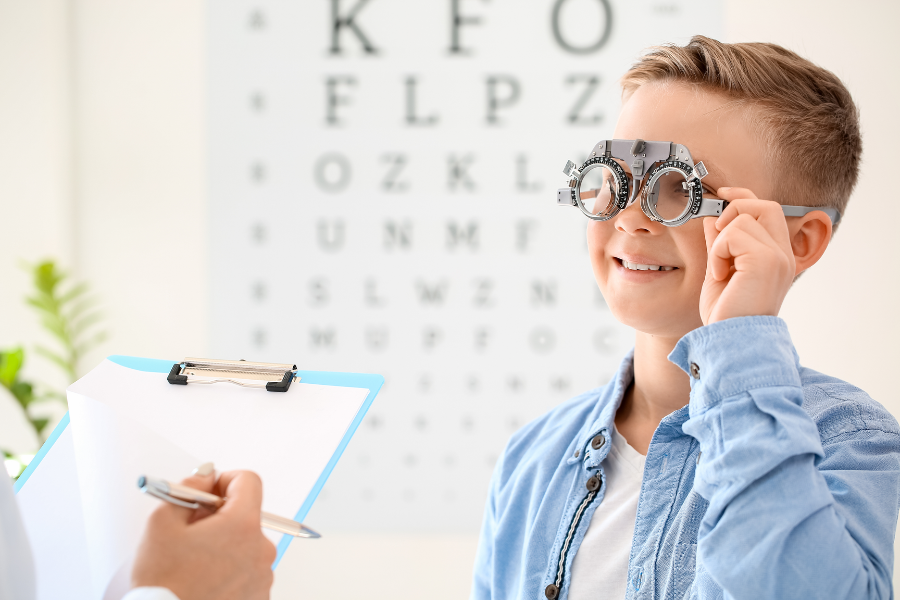
A comprehensive eye exam goes much further, evaluating how a child's eyes focus, track, and work together — the skills that matter most for reading and learning.
One in four school-age children has a vision problem that can affect learning — and most will never tell you something is wrong.
Myopia Is on the Rise — and Starting Earlier
Nearsightedness in children has increased significantly in recent years, driven by more screen time and less time outdoors. If your child's prescription is getting stronger year after year, it's worth asking about myopia management — a set of strategies designed to slow progression and protect their long-term vision.
Early intervention matters. The sooner myopia is identified and managed, the better the outcome.
The Bottom Line
At Eyes on Litchfield, we provide thorough pediatric eye exams that go well beyond a basic screening. We evaluate your child's visual development, check for conditions that can interfere with learning, and offer myopia management when it's needed. Our goal is simple — make sure your child's eyes are ready for the classroom.



.png)